
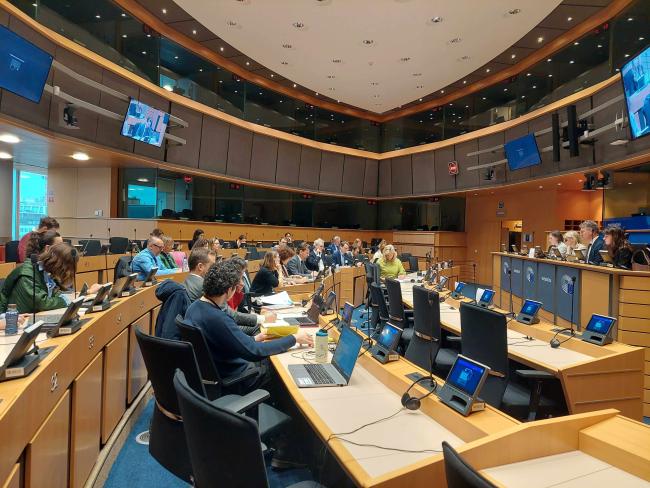
Earlier this month, on the 13th of January, EIBF was invited to attend a meeting of the European Parliament’s working group on the implementation of the Digital Markets Act (DMA), to discuss Amazon’s compliance with its obligations under the DMA. The legislation aims to ensure fair digital markets by regulating large online platforms (such as Amazon) to prevent them from abusing their market power.
The working group, formed by several members of the European Parliament (MEPs) in the Internal Market and Consumer Protection (IMCO) committee, aims to conduct in-depth analysis on the DMA, and evaluate whether it is being adequately implemented. The chair of the working group, MEP Andreas Schwab (EPP), along with working group members and fellow MEPs Cynthia Ní Mhurchú (Renew) and Gheorghe Piperea (ECR) were present at the meeting.
EIBF was one of the stakeholders invited to share their experiences and observations on the impact of the DMA, along with the trade associations SMEUnited and European Digital SME Alliance. Representatives from Amazon were also present to provide their perspective.
As always, EIBF outlined and reiterated the numerous qualms and issues about Amazon’s conduct vis-à-vis the obligations laid out in the DMA, specifically when it comes to bookselling and booksellers. Indeed, Amazon’s dominance in the book market is raising serious concerns under the DMA, despite the legislation's aim and attempts to curb these issues.
Amazon’s dominance in the book market is creating an unfair and unlevel playing field for independent booksellers. The company acts as both a marketplace for other sellers and a direct retailer of its own books, but current regulations don’t fully cover both roles. This allows Amazon to potentially favour its own products, often pushing competitors (which, once again, also happen to be their clients on the same platform) out of prime sales spots without clear justification.
Booksellers also face hidden barriers, such as restrictions on pricing and pre-orders, as well as extra fees that don’t apply to Amazon’s own sales, which further bolster inequality and unfairness: these practices make it nearly impossible for independent shops to compete on equal terms. At the same time, the lack of transparency around Amazon’s decisions makes it difficult for booksellers to even understand, let alone challenge, these unfair advantages, creating a vicious cycle leading to a situation of impasse and inertia.
In short, Amazon’s dual role and the gaps in oversight are not just hurting competition, they’re threatening the survival of independent bookshops, and the wider system of SMEs, across Europe. Without stronger enforcement, the diversity and vitality of the book market are at risk, which will not only lead to adverse economic consequences, but will also in turn gravely hinder our access to cultural diversity and freedom, a pillar of our democratic societies.
EIBF will continue to monitor DMA implementation and provide evidence to policymakers when possible. Fair competition on equal terms is one of EIBF’s core objectives and we always encourage members to get in touch should they have any input on the implementation and impact of the DMA.